Ensuring smooth knowledge transfer during career changes

Building A Knowledge Management System for Successors
Purpose and value of knowledge management in employee transitions, Capturing knowledge from emails, conversations, site visits, and training, Transforming tacit knowledge into structured models using AI and LLMs, Validation, storage, transfer, and continuous improvement of knowledge.
Purpose And Value Of Knowledge Management In Employee Transitions
- Tacit Knowledge Importance
Long-tenured employees hold tacit knowledge crucial for operational efficiency and decision-making. - Continuity and Documentation
Knowledge management captures both task execution and the reasoning behind decisions for continuity. - Business Benefits
Effective knowledge management reduces onboarding time and protects critical capabilities during transitions. - Human and AI Collaboration
AI assists in organizing data, but human expertise ensures accuracy and relevance in knowledge validation.

Knowledge management plays a critical role when employees retire or move to new jobs because a significant portion of organizational value resides in human experience rather than formal documentation. Long-tenured employees accumulate tacit knowledge such as troubleshooting intuition, decision rationale, customer history, informal networks, and process shortcuts that are rarely written down. When this knowledge leaves the organization abruptly, teams often experience operational delays, quality issues, increased costs, and dependence on former employees as external consultants. The primary purpose of knowledge management in this context is to transform individual know-how into organizational knowledge that can be reused, trusted, and continuously improved by successors and future generations. A well-designed knowledge management approach ensures continuity by capturing not only what tasks are performed, but also why they are performed in a certain way and under which conditions decisions change.
This includes documenting historical context, risk awareness, failure patterns, and lessons learned that are otherwise invisible in standard operating procedures. From a business perspective, effective knowledge management reduces onboarding time for successors, stabilizes customer and supplier relationships, and protects critical capabilities during workforce transitions. It also supports succession planning by making expertise transferable rather than person-dependent. Modern approaches increasingly combine human-centered methods such as interviews, mentoring, and storytelling with digital platforms such as internal wikis, document repositories, and learning management systems. Artificial intelligence further enhances this process by summarizing large volumes of unstructured data, identifying recurring themes, and supporting fast retrieval of relevant information.
However, the value of knowledge management ultimately depends on human validation and governance. AI can assist with structuring and analyzing information, but experienced professionals must still confirm accuracy, relevance, and limitations. When implemented as an ongoing organizational practice rather than a one-time exit activity, knowledge management becomes a strategic asset that enables resilience, learning, and long-term performance across employee generations.
Capturing Knowledge From Emails, Conversations, Site Visits, And Training
- Systematic Knowledge Gathering
Gather information from diverse sources like emails, calls, reports, and training materials to capture fragmented knowledge effectively. - Experiential and Contextual Insights
Site visits and conversations reveal experiential knowledge and subtle contextual cues not found in formal documents. - Structured Documentation
Logging captured knowledge with context, dates, and stakeholders helps prevent data overload and supports further knowledge transformation. - Combining Methods for Deep Capture
Using document reviews, interviews, and shadowing ensures thorough understanding and reduces loss of critical insights during transitions.

The first operational step in knowledge management during retirement or job transition is the systematic gathering of information from all relevant sources where knowledge is created and exchanged. Much of this information is fragmented across emails, telephone conversations, meeting minutes, site visit reports, training materials, presentations, and informal notes. While formal documents often describe processes and results, the underlying decision logic and contextual understanding are embedded in human communication.
A structured capture approach therefore starts by identifying key knowledge sources linked to the employee’s role, projects, customers, suppliers, and technical responsibilities. Emails may reveal decision histories, problem escalations, and stakeholder expectations, while call summaries and meeting notes provide insight into negotiation tactics, risk assessments, and coordination practices. Site visits often generate experiential knowledge, such as environmental constraints, operator behavior, and real-world deviations from documented procedures. Training workshops and presentations reflect how experts explain complex topics and which aspects they emphasize as critical. To extract maximum value, organizations should combine document collection with targeted interviews and observation. For example, reviewing selected emails together with the retiring employee can help clarify why certain actions were taken and which signals triggered decisions.
Shadowing during site visits allows successors to observe subtle cues that are difficult to articulate, such as safety awareness, communication style, or prioritization under pressure. All captured information should be logged in a structured manner, with references to context, date, stakeholders, and relevance. This ensures that raw data does not become an unmanageable archive but instead serves as input for further transformation. By treating communication artifacts and experiential inputs as primary knowledge assets rather than by-products of work, organizations can significantly reduce the risk of losing critical insights during employee transitions.
Transforming Tacit Knowledge Into Structured Models Using Ai And LLMs
- Tacit Knowledge Challenges
Tacit knowledge includes intuition and judgment often unformalized, posing challenges for structured reuse. - Human-Centered Externalization
Wiki-style articles with examples and diagrams enable incremental refinement and contextual explanation. - AI and LLM Assistance
AI summarizes transcripts, extracts key concepts, clusters cases, and identifies recurring patterns effectively. - Structured Reasoning Models
Models map inputs to causes and actions, supporting human decision-making with expert validation.
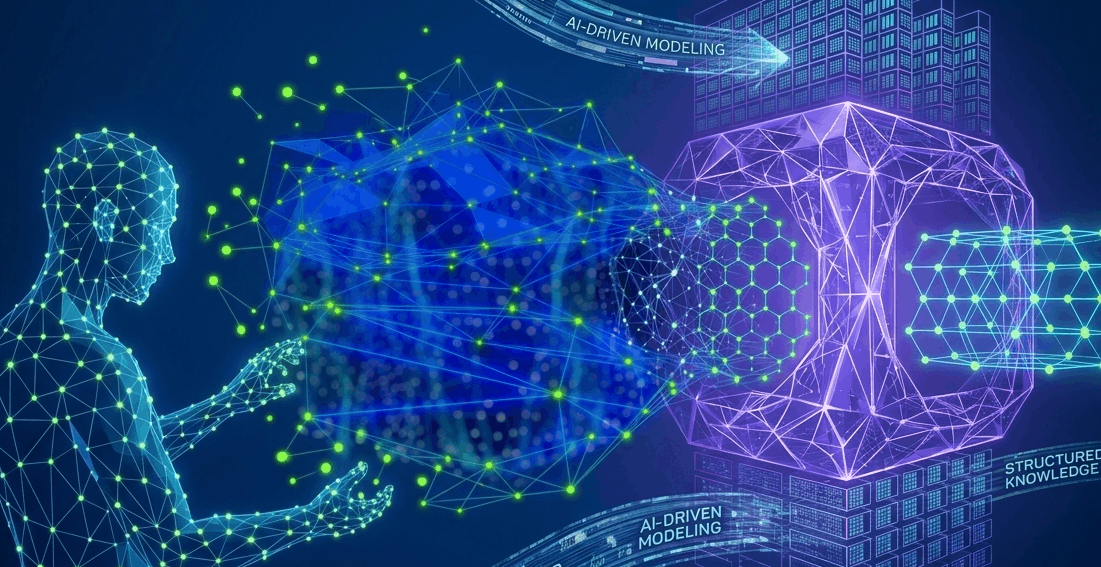
After knowledge has been gathered from diverse sources, the central challenge is converting tacit human understanding into explicit, structured knowledge that can be reused by others. Tacit knowledge includes intuition, pattern recognition, heuristics, and experiential judgment that experts apply without consciously formalizing their reasoning. Traditional methods such as manuals and checklists capture only part of this richness. Modern knowledge management systems therefore combine human-centered externalization techniques with AI-supported processing. Wiki-style articles are an effective foundation because they allow incremental refinement, linking, and contextual explanation.
Experts can describe processes in natural language, supported by examples, diagrams, and decision trees. Artificial intelligence and large language models can then assist by summarizing long interview transcripts, extracting key concepts from emails, clustering similar cases, and identifying recurring problem patterns. More advanced applications involve mapping human communication patterns into logical structures resembling neural networks, where inputs such as symptoms, operating conditions, or customer constraints are linked to probable causes and recommended actions. Within this framework, objective functions can be defined, such as minimizing downtime, reducing safety risk, or optimizing cost. LLM-based reasoning layers can analyze new user inputs against stored cases and models, highlighting similarities and suggesting next steps. Importantly, these models should not be treated as autonomous decision-makers.
Their role is to support human reasoning by making implicit logic visible and accessible. Validation by subject-matter experts remains essential to ensure that assumptions, boundary conditions, and ethical considerations are respected. When properly governed, AI-enhanced knowledge models significantly improve accuracy, speed, and consistency of decision support for successors while preserving the depth of expert experience.
Validation, Storage, Transfer, And Continuous Improvement Of Knowledge
- Knowledge Validation Process
Retiring employees and managers validate documented knowledge using real or historical cases to ensure accuracy and limitations. - Controlled Knowledge Storage
Validated knowledge is stored in controlled repositories with clear ownership, version control, access rights, and review schedules. - Active Knowledge Transfer
Successors internalize knowledge through mentoring, workshops, job shadowing, and practical case-solving during structured handovers. - Continuous Knowledge Improvement
Feedback, analytics, and new lessons continuously update the knowledge base, fostering organizational learning and resilience.
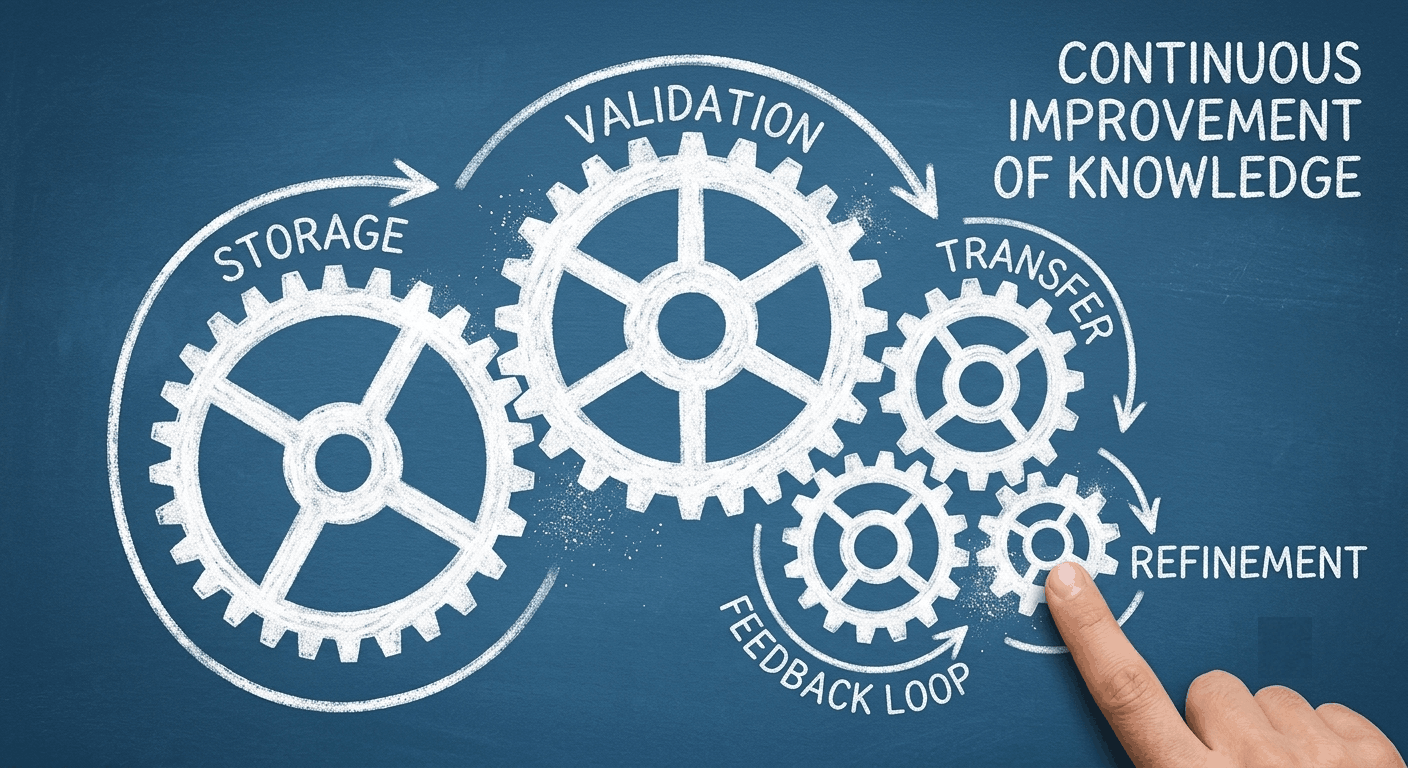
The final stages of knowledge management focus on ensuring that captured knowledge is trustworthy, accessible, and effectively transferred to successors. Validation is a critical control step in which the retiring employee, successor, and relevant managers or technical authorities review the documented content and models. This review should test real or historical cases to confirm that the knowledge leads to correct conclusions and highlights its limitations. Once validated, knowledge must be stored in a controlled repository such as a corporate wiki, SharePoint environment, learning management system, or knowledge graph.
Each knowledge item should have a clear owner, version history, access rights, and review date to prevent decay and misuse. Storage alone, however, does not guarantee continuity. Knowledge transfer requires active internalization by successors through mentoring, job shadowing, workshops, simulations, and guided problem-solving. Explicit documents become effective only when they are applied in practice and integrated into the successor’s own experience. Organizations should therefore plan structured handover periods in which successors demonstrate their understanding by solving cases using the knowledge base. After the transition, continuous improvement ensures long-term value. Usage analytics, search queries, and feedback reveal which knowledge is most critical and where gaps remain. New cases, lessons learned, and process changes should be regularly incorporated, creating a feedback loop that updates the knowledge system over time.
In this way, knowledge management evolves from a one-time retirement activity into a living organizational capability that supports learning, resilience, and sustainable performance across generations of employees.